Scientists solve mystery of strange signals from distant object
07 Jan 2022 16:48:28
New Delhi, January 7: Astronomers examined potential causes behind strange signals which a dusty object captured by the Transiting Exoplanet Survey Satellite (TESS) was emitting. They were trying to understand the source of these signals noticed by sudden changes in brightness of this object. Now, they have identified a double star system.
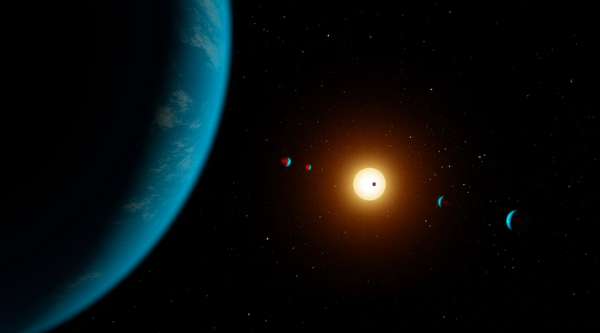
Astronomers used several facilities to study TIC 400799224. They found that the object could be a binary system in which one of the stars pulsates with a 19.77-day period, maybe from an orbiting body that emits clouds of dust that occult the star.
"While the periodicity is strict, the dust occultations of the star are erratic in their shapes, depths, and durations, and are detectable (at least from the ground) only about one-third of the time or less," said a statement from Harvard-Smithsonian Center for Astrophysics.
However, observations over the last 6 years have shown that the periodicity has remained strict and the object emitting the dust apparently has remained intact. Astronomers now plan to monitor the object and to incorporate historical observations of the sky to try to determine its variations over several decades.
The TESS, launched in 2018, works to discover small planets around the Sun’s nearest neighbour stars. The spacecraft has so far detected 172 confirmed exoplanets and compiled a list of 4703 candidate exoplanets.
According to the media house, the strange signals, found by astronomer Karen Collins, were coming from a variable object TIC 400799224. The object was spotted because of its swift drop in brightness, by almost 25% in just a few hours. The sudden brightness drop was followed by several sharp brightness variations that astronomers interpreted to be an eclipse.
Astronomers used several facilities to study TIC 400799224. They found that the object could be a binary system in which one of the stars pulsates with a 19.77-day period, maybe from an orbiting body that emits clouds of dust that occult the star.
"While the periodicity is strict, the dust occultations of the star are erratic in their shapes, depths, and durations, and are detectable (at least from the ground) only about one-third of the time or less," said a statement from Harvard-Smithsonian Center for Astrophysics.
Also Read | ESA spots James Webb Space Telescope into space; releases images
Astronomers say that the nature of this orbiting body itself is strange as the quantity of dust emitted is large. If it were produced by disintegration of an object like asteroid Ceres in our solar system, it would survive only about 8000 years, before disappearing.
However, observations over the last 6 years have shown that the periodicity has remained strict and the object emitting the dust apparently has remained intact. Astronomers now plan to monitor the object and to incorporate historical observations of the sky to try to determine its variations over several decades.
The TESS, launched in 2018, works to discover small planets around the Sun’s nearest neighbour stars. The spacecraft has so far detected 172 confirmed exoplanets and compiled a list of 4703 candidate exoplanets.